
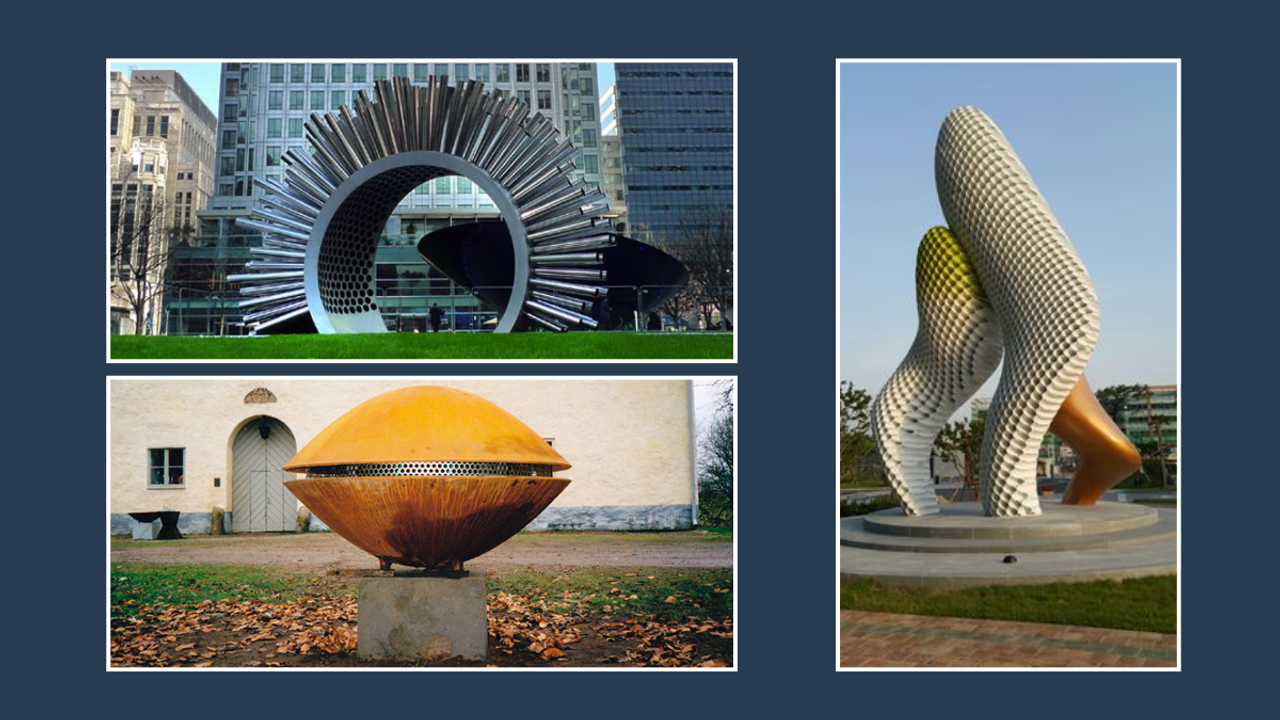
Sound sculptures are physical works of art that produce or manipulate sound as an essential part of their form. Unlike traditional musical instruments, they are designed as spatial, visual, and acoustic experiences. Central to their effect is material—what the sculpture is made of directly influences how it sounds, behaves, and interacts with its environment. Whether it’s the hum of metal in the wind or the resonance of stone under touch, the sonic identity of a sound sculpture begins with its substance.
Below, we explore how different materials shape these experiences—along with real-world examples where these materials take center stage.
Metal – Resonance, Sustain, and Wind-Borne Harmony
Example: Singing Ringing Tree
Artist: Mike Tonkin and Anna Liu
Location: Burnley, Lancashire, England
Year: 2006

The Singing Ringing Tree is an award-winning, wind-activated sound sculpture made entirely of galvanized steel pipes. Standing three meters tall on a hill overlooking the town of Burnley, this sculpture is both a visual landmark and an acoustic instrument. Each steel pipe is tuned to a specific frequency. As wind flows through openings cut into the pipes, the tree emits haunting, organ-like tones that shift with weather conditions.
Metal is ideal for this type of work due to its ability to carry and sustain vibrations. Its durability also makes it well-suited for large-scale outdoor installations. In this piece, the material’s sonic clarity and endurance create a constantly evolving soundscape rooted in its environment.
Wood – Warmth, Texture, and Interactive Possibilities
Example: A Sound Garden
Artist: Douglas Hollis
Location: NOAA Western Regional Center, Seattle, USA
Year: 1990s
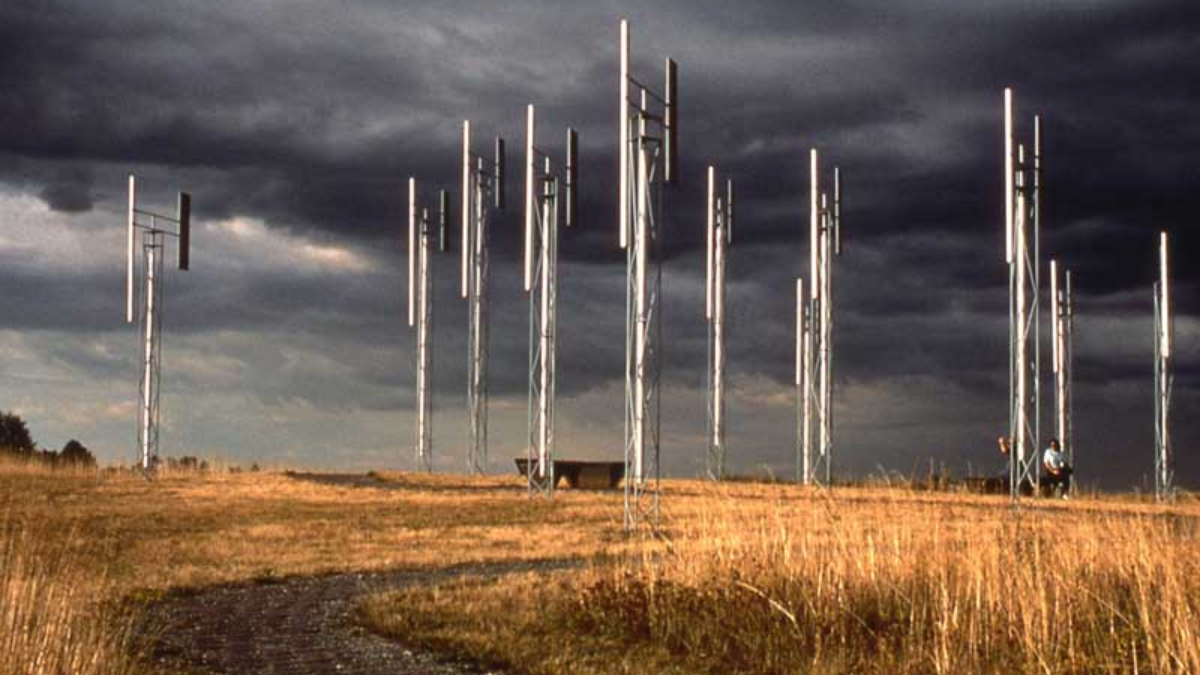
Douglas Hollis’s A Sound Garden is a wind-activated installation consisting of twelve tall, steel towers mounted with rotating organ pipes. These towers are anchored by wood and steel bases and placed along the waterfront. As wind moves through the structure, air is funnelled through the pipes, generating whistling tones of varying pitch.
While metal generates the sound, the structural use of wood affects the sculpture’s tactile presence and resonance. Wood absorbs some vibrations and contributes warmth to the visual and physical form. Hollis’ work is a prime example of how wood can be used as a supporting element in larger sonic systems—especially in outdoor environments.
Stone – Density, Impact, and Timeless Form
Example: Time Drums
Artist: Gary Smith
Location: Florida Gulf Coast University, Fort Myers, USA
Year: 1996
Gary Smith’s Time Drums is an interactive sound sculpture embedded in the university’s campus plaza. The installation features circular stone forms placed flush with the ground, designed to be walked on, struck, or tapped. While not tuned in the traditional musical sense, the pieces are built to produce short, resonant sounds when physically engaged.
Stone, with its mass and density, produces clean, percussive tones. Unlike materials that sustain vibration, stone tends to reflect impact in sharp, immediate bursts of sound. Its solidity and permanence also lend symbolic weight—conveying a sense of durability and grounding in the space it occupies.
Glass – Clarity, Fragility, and Harmonic Precision
Example: Glass Harp Installation (Untitled)
Artist: Trimpin
Location: Various, including Pilchuck Glass School (Washington, USA)
Year: Ongoing works since the 1990s
Trimpin, a German-American sound sculptor and kinetic artist, frequently works with glass in his installations. His untitled glass harp installations feature suspended glass rods or bowls that emit high, pure tones when touched or vibrated. These works are often part of interactive environments where sound is generated by movement, sensors, or even computer control.
Glass offers a bright, ringing harmonic tone but requires precise shaping and handling due to its fragility. Trimpin’s approach showcases how glass can contribute both visually and sonically—creating ethereal sounds that echo the material’s delicate, translucent nature.
Ceramic and Clay – Earthy Resonance and Sculptural Form
Example: Sonic Playground
Artist: Yuri Suzuki
Location: High Museum of Art, Atlanta, USA
Year: 2018
Ceramic and clay offer an earthy, tactile quality to sound sculptures and are prized for their sculptural flexibility and acoustic range. The acoustic properties of clay vary depending on its composition and treatment: more porous, unglazed clay tends to produce softer, dampened tones, while fired and glazed ceramics yield sharper, clearer sounds. These characteristics allow artists to create pieces that don’t just look organic but also sound earthy, rounded, or percussive, depending on how the forms are shaped and finished.
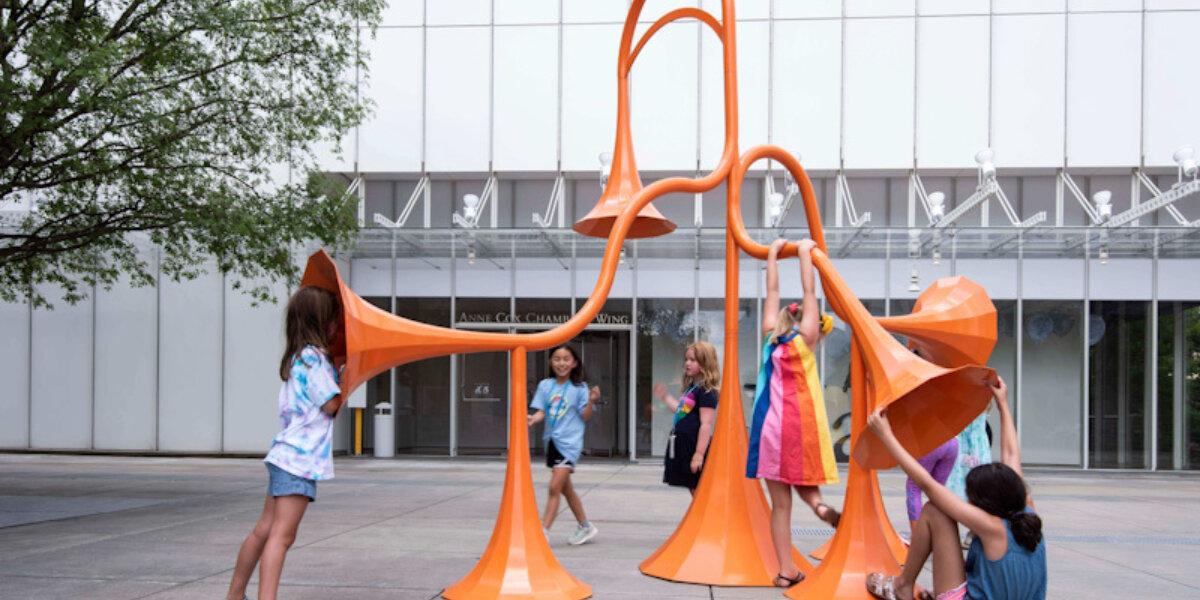
Yuri Suzuki’s Sonic Playground was an interactive outdoor installation featuring large, horn-shaped structures that channelled, redirected, and modulated human voices across a public plaza. While the final pieces were fabricated from industrial materials for durability, the forms and surface aesthetics were inspired by ceramic vessels. The design incorporated molded curves and acoustic chambers that mimicked how clay responds to sound—soft, warm, and grounded.
By scaling up and playfully arranging these forms in bright colours and approachable shapes, Suzuki created a sonic game board where the audience’s participation completed the artwork. Although not made of literal ceramic, the installation successfully borrowed from its material language—both visually and acoustically—highlighting how the principles of ceramic resonance can shape public sound environments.
Found Materials and Mixed Media – Reuse, Raw Sound, and Environmentality
Example: Wind Fence
Artist: Bill Fontana
Location: Fort Marfa, New Mexico, USA
Year: 1980
In Wind Fence, artist Bill Fontana used an actual chain-link fence as a resonating object. Tensioned wires and attached metal elements picked up the motion and sound of the wind, translating them into vibrations amplified by microphones. The result is a subtle, ambient sonic landscape—one that emerges from materials never intended to make music.
Found and industrial materials expand the definition of what a sound sculpture can be. They offer unpredictable textures and challenge the line between noise and music. Fontana’s work is particularly influential in showing how everyday environments can become instruments with the right framing.
When Materials in Sound Sculptures Speak
In sound sculptures, material isn’t just structural—it’s expressive. It determines not only what a sculpture looks like, but what it sounds like, how it’s interacted with, and how it ages in its environment. Metal sings, stone strikes, glass shimmers, and found objects hum with unrefined life.
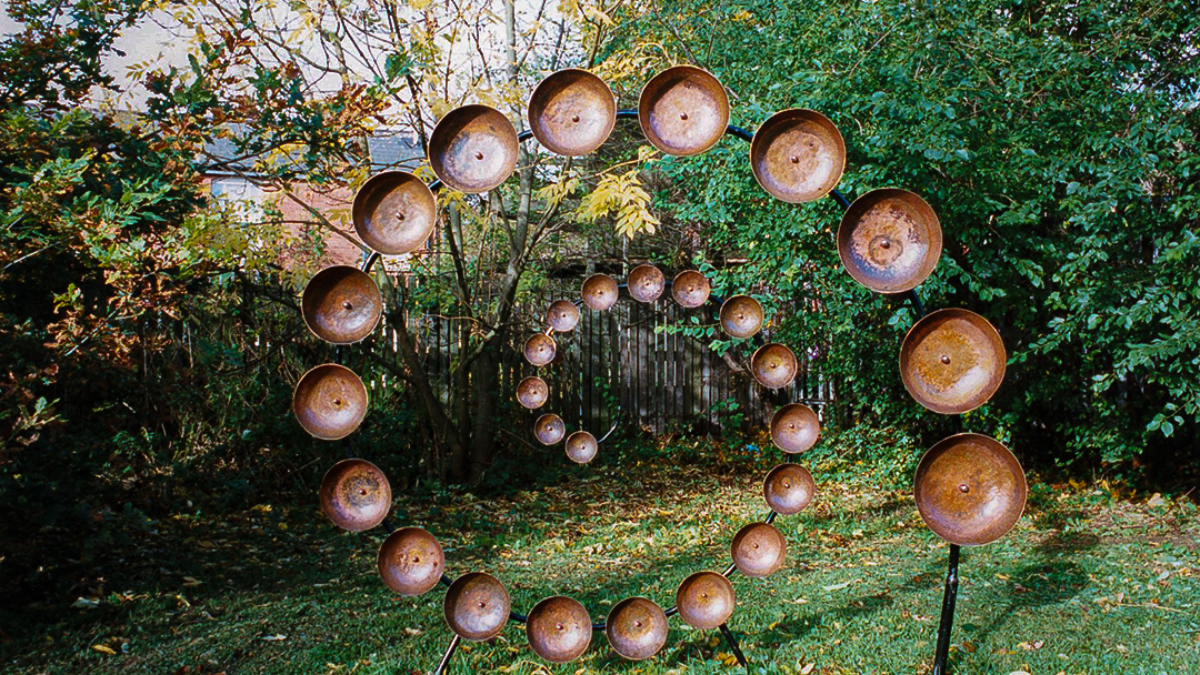
Each artist chooses their materials deliberately, not only for their physical properties but also for the metaphors they carry. In this way, every sound sculpture becomes a conversation between material, movement, environment, and listener—a space where art doesn’t just appear, but is heard.
Also Read: Brutalism as a Backdrop for High Fashion
---Silviya.Y